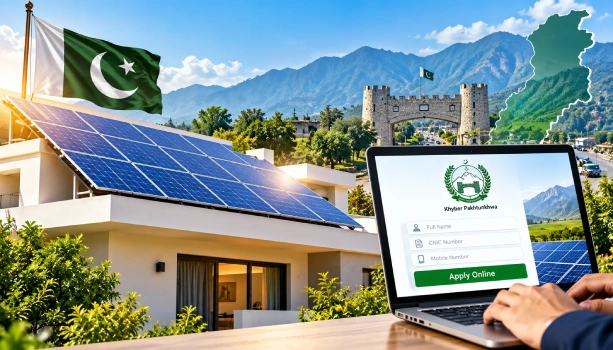
The Khyber Pakhtunkhwa government is giving free and subsidized solar systems to homes across the province. If you want to know how the KPK solar scheme online apply process works, who can join, and what documents you need, this guide covers it in simple steps.
What Is the KPK Solar Scheme?
The KPK Solar Scheme, also known as the Khyber Pakhtunkhwa Household Solarization Scheme, is a government program that gives solar power systems to homes in the province. The Pakhtunkhwa Energy Development Organization (PEDO) handles the technical work. The Bank of Khyber manages the financial and vendor side.
The scheme aims to reach 130,000 households across Khyber Pakhtunkhwa, including the merged districts. Of these:
- 65,000 households get a solar system completely free.
- 65,000 households get a system at half price, paid back in easy monthly installments.
The project was formally launched in 2025 at an estimated cost of Rs 20 billion.
What You Get Under the Scheme
- Free category: A solar system with panels, a battery, an inverter, and basic accessories such as fans and bulbs, at no cost.
- Subsidized category: A similar system, where you pay half the cost, usually spread across easy installments.
Who Can Apply (Eligibility)
Based on the official eligibility rules published by the KP Energy and Power Department:
- Households using up to 100 units of electricity a month can qualify for a system with no charge.
- Households using up to 200 units a month can also apply, sharing part of the cost with the government at an agreed rate.
- Priority goes to widows, divorced women, orphans, transgender persons, minorities, and persons with disabilities.
- Temporarily displaced families and residents of areas with no grid electricity also get priority.
- If more people apply than the number of solar units available, the government picks names through a computerized lottery, known as balloting. This keeps the process open and fair.
Documents You Will Need
- A valid CNIC
- Proof of your home address
- Your most recent electricity bill
- Proof of income, if requested during the process
Keep clear copies or photos of these ready before you start your application.
How to Apply Online
- Go to the official PEDO website (pedokp.gov.pk) and look for the “Free Solar” or “Household
- Solarization” section. Several guides also point to a dedicated portal at freesolar.pedokp.gov.pk.
- Enter your CNIC, phone number, and address.
- Add your household’s average electricity consumption.
- Upload a clear photo of your CNIC and your latest electricity bill.
- Submit the form and save your reference or tracking number.
Registration for each phase opens and closes on its own schedule. If the apply button isn’t active, the current round has likely not opened yet, or it has already closed.
How to Apply Offline
If you can’t apply online, or your area has poor internet access, visit your district’s Deputy Commissioner office. Ask for the solar scheme form, fill it in, and submit it along with your documents. This route is treated the same as an online application during balloting.
Solar Scheme for the Merged Districts
Apart from the main 130,000-household scheme, the KP government started a separate program in January 2026 for seven merged tribal districts: Bajaur, Khyber, Kurram, Orakzai, Mohmand, North Waziristan, and South Waziristan.
This program plans to reach 120,000 households, at a total cost of about Rs13 billion, fully funded by the KP government. Each home gets a 2kW solar kit with an inverter, at an estimated cost of Rs2.55 lakh to Rs3 lakh per unit.
Families in these districts can pick one of two options:
- A free system, at no cost.
- A refundable system, repaid over 36 monthly installments of around Rs8,300.
The Bank of Khyber appoints the vendors for this program, while PEDO provides technical support.
How Selection Works
Since more families usually apply than the number of solar units on offer, the government uses computerized balloting to choose winners. This is a random digital draw, not a manual pick, so results can’t be influenced. In the first phase, quotas were set by district population, so larger districts received a bigger share of the 32,500 slots.
A Word of Caution
The scheme does not charge any fee to apply or register. If anyone calls or messages asking for money to “confirm” your solar system, that’s a scam. Trust only the official PEDO website or your local DC office, and never share your CNIC, OTP, or bank details with unknown callers.
Latest Update (2026)
Former Chief Minister Ali Amin Khan Gandapur launched the scheme in mid-2025. In the first phase, 32,500 families were picked through computerized balloting after the program received more than 2.5 million online applications.
In March 2026, the new Chief Minister, Muhammad Sohail Afridi, held a review meeting and told officials to speed up distribution. At that meeting, officials said the project’s PC-1 document (the official project plan) was ready and would go to the Provincial Development Working Party for final approval. This means the second phase, covering the remaining households, was still moving through government approval at that point.
A separate solar program for the merged tribal districts also started in January 2026 (details below).
Because government timelines shift, check the official PEDO website or your district’s Deputy Commissioner office for the current registration status before you apply.