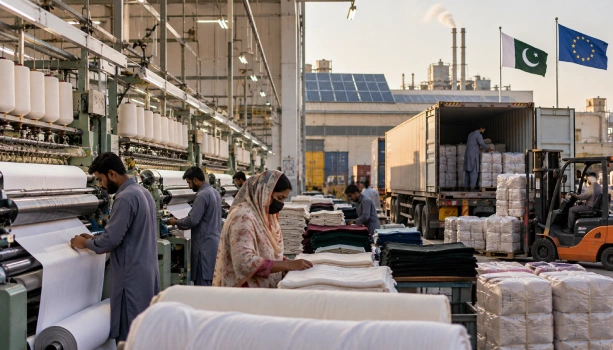
Pakistan's textile industry may soon face a new cost at Europe's border. The European Union is planning to expand its carbon tax to cover more goods. Textiles are on the list.
The EU is Pakistan's biggest export market. It takes about 28% of all Pakistani exports. In the last financial year, Pakistan sent around $7.1 billion worth of textiles and clothing to the EU. Most of that trade, about 90%, enters Europe duty-free. This is thanks to a trade deal called GSP+.
That free access could get harder to use.
What is the EU's carbon tax?
The EU calls it the Carbon Border Adjustment Mechanism, or CBAM. It went live on January 1, 2026. Right now, it covers six sectors: iron and steel, cement, aluminium, fertilisers, electricity, and hydrogen. Textiles are being considered for the next round.
Under CBAM, EU importers will have to pay a fee based on how much carbon was used to make a product. Goods made with dirtier energy will cost more to bring into Europe.
The EU is also rolling out a new rule called the Digital Product Passport. It's due by February 2027. This will require companies to report detailed data on how their goods are made, including their carbon footprint.