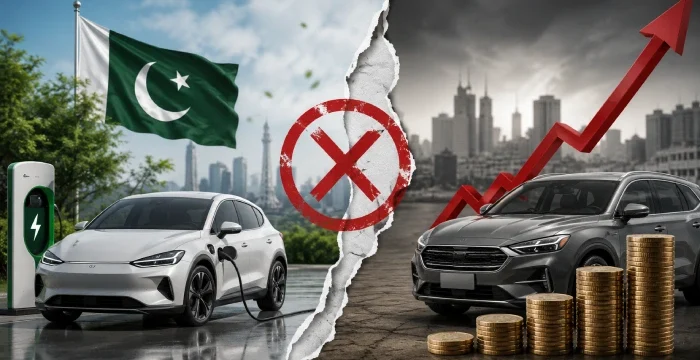
The federal government has shelved its new Auto Policy 2026-2031 after heavy pushback from car makers and local parts manufacturers. The delay has already pushed hybrid car prices up sharply for anyone buying one right now.
What Happened
The Ministry of Industries and Production had drafted the policy to speed up electric vehicle adoption and cut Pakistan’s oil import bill. Petroleum imports currently make up close to 80% of the country’s total fuel use.
Local car makers and the Pakistan Association of Automotive Parts & Accessories Manufacturers (PAAPAM) pushed back hard. Their concern: the policy favored pure EVs so heavily that it could turn Pakistan into little more than an assembly point for imported EV kits, putting existing local investment and manufacturing jobs at risk.
Prime Minister Shehbaz Sharif stepped in directly, and the policy was withdrawn. A committee led by Deputy Prime Minister Ishaq Dar has now been given the job of drafting a fresh, more balanced version.
What Industry Groups Are Asking For
PAAPAM and local manufacturers want three things built into the next draft:
- Incentives tied to local production: EV tax breaks should be linked to yearly targets for building batteries, motors, and power electronics inside Pakistan, not just importing finished EVs.
- Support for existing vendors: Help for current auto parts manufacturers to retool their factories for EV components instead of losing business entirely.
- A slower, phased shift: A gradual roadmap that lets local plants move from petrol and hybrid production into EV manufacturing over time, rather than all at once.
Why Your Hybrid Just Got More Expensive
Here’s where the real damage is happening right now. The old Auto Industry Development and Export Policy (2021-2026) expired on June 30, 2026. Since no replacement was ready in time, the Federal Board of Revenue automatically reinstated the full 25% General Sales Tax on locally assembled hybrid and plug-in hybrid vehicles. Before this, hybrids were taxed at a much lower 8.5%.
This tax jump is why Toyota (Indus Motor Company) and Honda Atlas have already raised hybrid model prices by Rs 1.3 million to Rs 1.5 million.
What This Means If You’re Planning to Buy a Hybrid
- Prices are up right now, and there’s no confirmed date for when, or if, a lower rate returns.
Industry groups are pushing for an 18% GST as a middle-ground fix while the new policy gets finalized, but this hasn’t been approved yet. - If you were planning to buy a hybrid soon, ask your dealer for the current on-road price before assuming older listed prices still apply.
- If you can wait, it may be worth holding off a few weeks to see if the interim tax rate gets approved, since it could bring prices back down somewhat.
- New EV model launches may also see delays until the government finalizes clear rules, so factor that in if you were waiting on a new electric model.
Bottom Line
Pakistan’s new EV policy is on hold while a fresh draft gets worked out, and in the meantime, hybrid buyers are paying the price, sometimes over a million rupees more than before. Until the new policy or an interim tax rate is confirmed, expect prices to stay high and hold off on assuming today’s price is the final one.